Franklin Street Studio’s audience and services had evolved. It was time for their words to catch up.
Before:
Unclear offer structure, a story rooted in their early education work, and a founder who felt off about how she and her team talked about their work.
After:
Three focused offers, language that speaks directly to foundations and social impact leaders, and a founder who can effortlessly describe the full scope of Franklin Street’s work in any room.
Britt Erickson started Franklin Street Studio five years ago with a hunch, a network, and a point of view. The Denver-based learning design consultancy helps social impact leaders turn ambitious goals into concrete action. From convenings that produce real commitments to fellowships that build leadership while advancing the work, Franklin Street’s expertise is shaping regions, industries, and organizations. But when they talked about their work, it wasn’t clear how to separate where they’ve been from where they’re headed.
For a founder who shows up to sales conversations, keynotes, and client calls dozens of times a year, Erickson felt like she was underselling work she knew was delivering real results.

I had all these words I would say, and I didn't feel good about them," Erickson said. "They felt outdated because they were the same words I was using when we were founded, and the work had evolved."
A partner to think with them, not just write for them
When they decided to get outside help, the obvious path was a copywriter. Erickson was skeptical. “Coming up with specific language without understanding why didn’t feel sufficient,” she said. “Best case scenario, messaging reflects your business strategy. We couldn't skip that part.”
They also considered doing it themselves. But the team had never been through this before. “It felt like the blind leading the blind,” she said.
Franklin Street set a higher bar. They wanted someone who had, in Erickson’s words, “a bit of pattern recognition for how teams go through talking about their work.” Not just a great workshop, but a partner who would stay with them through the messy strategic questions and then carry the lift of turning those decisions into language they could actually use.
“We're small, and we have a lot on our plates,” she said. “We wanted somebody who could hold both.”
Getting clear who they’re really for, and what really sells
The engagement opened questions the team hadn't fully worked through together:
Who is our ideal client now, and who isn't?
What’s really at stake for our clients?
What do we actually offer, and what's the thing nobody buys on its own?
That last question had a concrete answer. Franklin Street had four offerings on paper. Three of them actually sold. Naming that clearly, and understanding why, was exactly the kind of strategic clarity that better copy alone couldn't have produced.
The question of who they were talking to surfaced real tension, too. Franklin Street started in education, school systems, and nonprofits. That's not the core client anymore. Working through it as a team meant naming the shift, figuring out where those clients still fit, and landing on language that spoke to their new primary audience—foundations and larger social impact organizations—without writing off the clients who'd been there from the start.
“Our work has expanded quite a bit. It was both hard for our team to reckon with and also a very strategic question we needed to answer. We came in misaligned," Erickson said, "and ultimately landed in a good place."
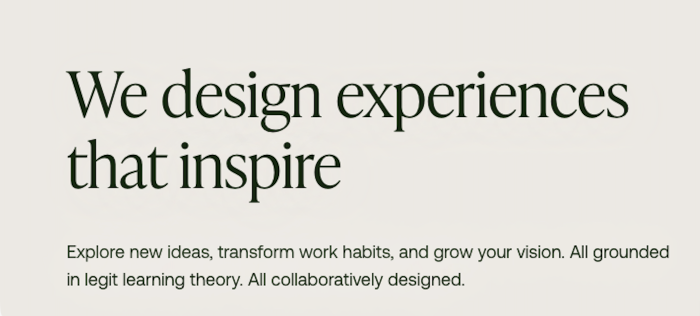
Before, a headline about “us” with vague language. Inspires what, exactly?
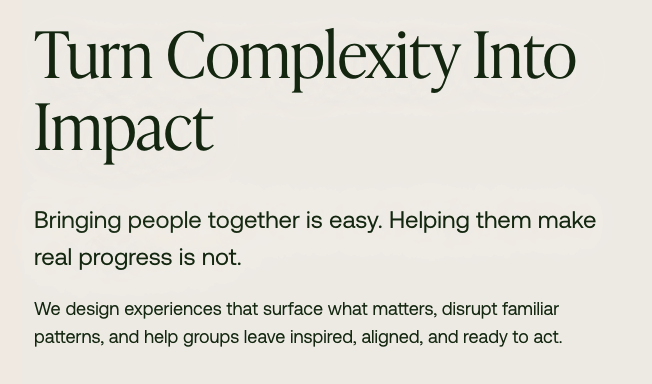
After, a headline that makes a promise, sets the stage, and uses client-derived language to introduce the work
Translating decisions into language they can use anywhere
Dreamboat spoke with Franklin Street's clients before the team aligned on language. The process moved between big questions and specific deliverables: a value proposition, offer descriptions, and language Erickson could use in any room. After a few rounds, she saw the first full message map and sent a voice note the same day.
“My very initial reaction was pure joy and thrill at having something that feels not only accurate to what we do, but also elegant, concise, and confident."
After shoring up the messaging foundation, Dreamboat moved to execution, creating website copy, service descriptions, and case studies that went live, right before Erickson walked into a room full of her ideal clients.
Two weeks later, the conversations changed
On a closing call with a long-term client, Erickson found herself naturally describing services they'd never worked on together. It was the kind of conversation she’d been missing before: confident, expansive, unselfconscious about the full scope of what Franklin Street offers.
Erickson hasn’t been a fan of marketing in general. In her experience, it had always felt like a performance. What surprised her most was that it didn't have to. "You should not feel like you're putting on a costume. At its very best," she said, "it can and should feel natural and authentic."
Industry: Social impact consulting Firm size: 2-10 members Dreamboat services: Messaging Foundation, Market-Ready Materials
If your work has outgrown the way you talk about it, Dreamboat helps. Start a conversation.